
Remota Coronam
Rejection of Duty

Pardon my Latin.
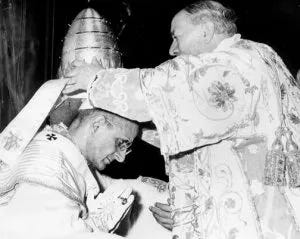
Remota Coronam, “Decoronation”, is a follow-up to Nulla Carona. I have been inspired by Unam Sanctam to continue these thoughts. Thanks to Ian at Early Christian Beliefs for bringing this papal bull of Boniface VIII to my attention. Today is the 722nd anniversary of the bull’s promulgation.
The more we consider the significance of Paul 6 removing his papal crown we are forced to see a crux in the road. Perhaps there are many wrong ways to read the symbolic meaning of this event, but there will be only one truth about it; either it was an act honoured and accepted by Christ or it was a symbol of a great Apostasy. Actually we need to set the bar as high as we can on this one, Paul 6’s symbolic abdication was either directed by the Holy Spirit, or by the devil, though permitted by God to sift the Church. It cannot be taken as a private act; by decoronation he either legitimately and utterly transformed the papacy in a single gesture, or he removed himself from legitimate office.
In a social order like the Catholic Church, and there is no other one like it, we have both carefully presented theological proclamations, such as Unam Sanctam along with wordless symbols which embody these formulae. In this case, the Papal Tiara and Unam Sanctam, are two expressions of the unity of the Church in its structure, and its place in the world. Neither of which are the thing in itself, but both are required to form the members of the body into the upward presenting spiritual intention of the One Holy Catholic and Apostolic Church. And this structure is not, according to Boniface, a simple hierarchy of one above all the rest, but is a continuum leading up to the head,
For, according to the Blessed Dionysius, it is a law of the divinity that the lowest things reach the highest place by intermediaries. Then, according to the order of the universe, all things are not led back to order equally and immediately, but the lowest by the intermediary, and the inferior by the superior.
Place Paul 6’s Remota Coronam within the Old Testament canon, or in the Medieval Church; there is no way to ho hum our way out of its significance. And for those inclined to downplay the significance, as if the crown were a symbol which no longer ‘works’ in the Modern age. This demythologization is exactly the work of the conciliar radicals who usurped the ecclesiastical intention of the Catholic Church, willing to make it into something that better suited themselves as metaphysically doubtful ‘modern men’. So, taking this symbol lightly is to come down on the side of revolution, the simpering duplicitous revolution we have been fighting or under since the 19th century.
No, we must give this symbolic act of abnegation the full weight of its meaning. As such we must implore the Spirit to inform us whether this action was of Christ, or of the devil, as there can be no other possible affect: the act cannot be neutral to spiritual intention. To put it another way, Either Christ intended to have His earthly authority dispersed throughout the Body, among ‘the poor’, that He intended to overthrow Unam Sanctam, or Paul 6 rebelled against the divine order by despising the authority bestowed on him. There are those who will argue that Paul 6 never intended to fulfill the received duties of office, and I am one of these. The symbolic thesis put forward here is meant only to illustrate a moment when the defect of intent was visible to all, an act, the meaning of which, requires no special training to grasp, and does not require that we each must unravel all the post modern ambiguities of the conciliar and following documents to realize the papacy is vacant.
Certainly a good deal of careful theological work needs to be done, and much has already been done, to determine the particular errors of the council, the popes, the ecclesiastical authorities, and the lay people which followed Vatican 2. Yet, we have been provided an obvious symbolic act, when the man who was supposed to be Pope, rejected the Papacy ! And no one elected to that office since has revived it, but rather have continued in its rejection and diminution. Yet, each has at times assumed the supreme authority of the Papal office when expedient, without first submitting to the form of the office, exercising certain privileges while repudiating duties ascribed by the Vatican council, and in Unam Sanctam before.
There is a common belief in the Novus Ordo sect today that their pope has a duty and privilege to make the Church ‘work’ for the modern age. Yet, the duties of the papacy, from its institution by Christ is found in Chapter 4, section 2 of the Vatican council of the 1870s, quoting the Council of Lyons (undated); we see the historical confirmation of Papal primacy, and its principle duty of “defending the truth of the faith”.
For the holy Spirit was promised to the successors of Peter not so that they might, by his revelation, make known some new doctrine, but that, by his assistance, they might religiously guard and faithfully expound the revelation or deposit of faith transmitted by the apostles. (Emphasis original)
As was written in Nulla Carona, Paul 6’s self decoronation is often seen as an implicit rejection of temporal authority. Yet, by Unam Sanctam This authority is non fungible for the papacy. As by Boniface VIII’s reference to Christ telling Peter to put his sword back in its sheath after the disciple struck the high priest’s servant. He did not tell him to put it away for ever, or lay it down, or even to beat it into a plowshare. It was one of the two swords the Apostles said they had when asked by Christ, and Boniface reveals that one of these represented the spiritual authority and the other the temporal authority of the Petrine Office. It was not possible for Paul 6 to divest himself of temporal authority, so this cannot be a virtuous off the cuff interpretation of his act.
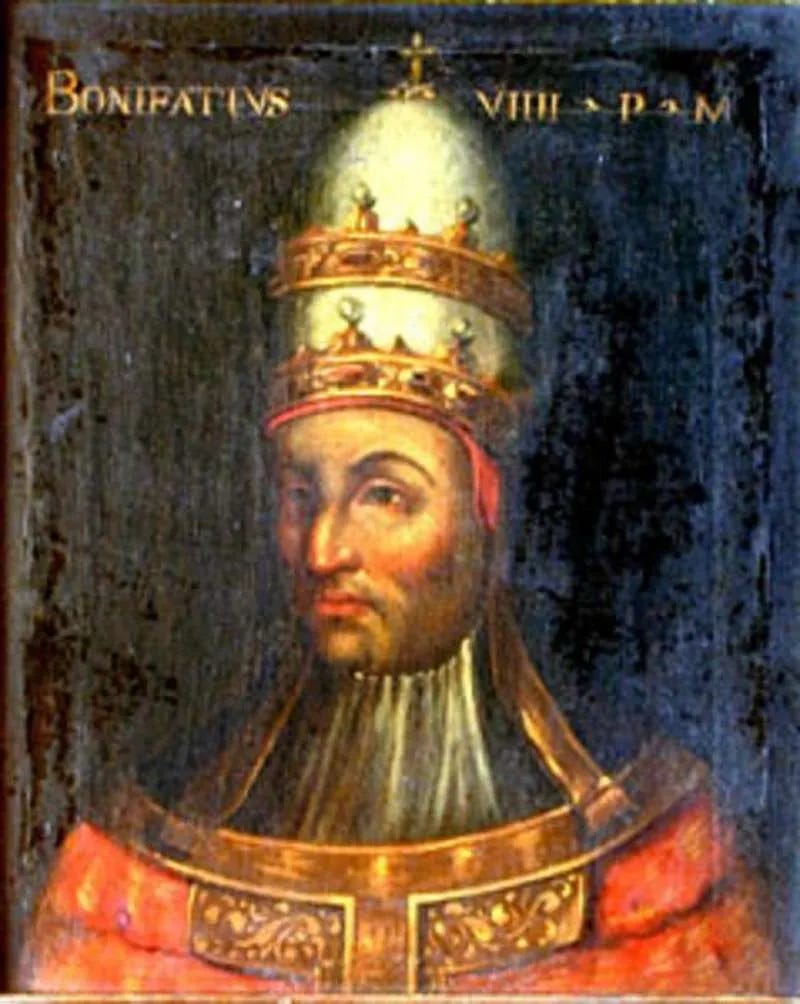
The opening clause of Boniface’s Bull reads,
Boniface, Bishop, Servant of the servants of God.
For perpetual remembrance.
It is curious that “For perpetual remembrance” is not included in the online Vatican archive version of the Bull. These are the subtle indicators of the revolt trying to conceal itself. For, the Modernists and Postmodernists reject the body of Unam Sanctam, while they continue to use the essence of the absolute authority of the papacy, found in the summary sentences of the bull, as a scourge against counter revolutionaries.
To make an informed assessment of the possible virtue of the conciliar reforms, it is worthwhile to read through all of St Francis de Sale’s The Catholic Controversy in light of the seed of a new church planted at Vatican 2, placing the Novus Ordo in the stead of the Protestant sects the saint was addressing. He lays out principles with which to assess the extraordinary claims of reform mission. This from the section of Mission the third Chapter, start of the second paragraph:
First, I say then that no one should allege an extraordinary mission unless he prove it by miracles: for, I pray you, where should we be if this pretext of extraordinary mission was to be accepted without proof? Would it not be a cloak for all sorts of reveries? Arius, Marcion, Montanus, Messalius—could they not be received into this dignity of reformers, by swearing the same oath?
This is a bold insistence to our Modernized ears. And no doubt would be received by the Novus Ordo hierarchy with quaint disdain.
So let’s lower the bar a bit. St Francis also goes through the four marks of the One, Holy, Catholic, and Apostolic Church, using these as a scale to measure the Protestant sects against. He says that apart from heavenly recommendation vouchsafed through miracles, the reform should at least show its heavenly sanction by increasing sanctity among the faithful. The Novus Ordo sect is a byword for degeneracy of the worst kind. We know many in the hierarchy are morally corrupt, that grooming and molestation of youths and children has been common and covered up. And that this perversion has been used as a means of forming and controlling the next generation of clergy in not a few seminaries and diocese. We do not know the full extent of this malignancy , but it is horrific and shameful that those who have stolen the name Catholic should so despise Jesus.
So, even without requiring miracles, the general virtue in the Church plummeted after the council. And this was the true extraordinary mark of the Intramural Reformation, the absolute gutting of the Catholic Church on all fronts, and the world following as it led the way. By this one graph showing the drop off of vocations for nuns in the mid 1960s we see and example of an oft repeated indication of mass apostasy in all areas of Church life.
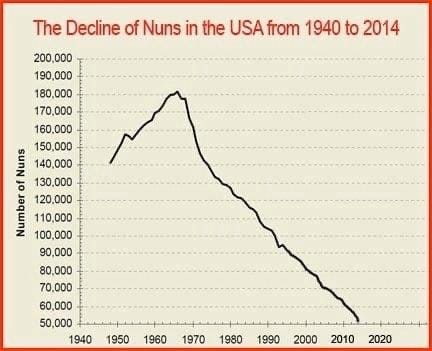
If we look at the world through the eyes of the faith. We know that Unam Sanctam and the Vatican council of the 19th century are not an all to human or antiquated grab at power, but are a truthful description of of how Christ works in the world through His Church. And as the Church under Novus Ordo occupation began to fall into moral and doctrinal degradation there was no more bulwark offered by the Church against social decay. In removing his crown, Paul 6 refused his office, and all the acts which followed were invalid and led to universal degradation.
It is clear that the reforms, which were promised to refresh the Church and the world, had quite the opposite effect. So there is no sign of sanctity by which we can say, “Yes, the council introduced extraordinary reforms to traditional faith and ecclesiology, but see the good fruits, surely God is the substance of these reforms.”
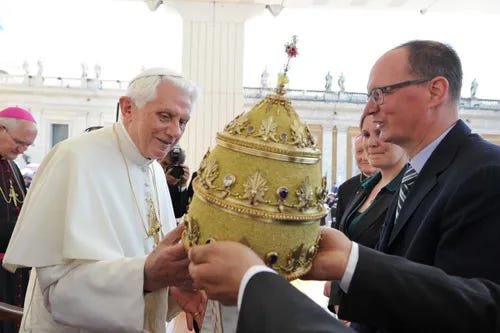
In my research on the Papal Tiara I discovered an article from the Catholic News Agency about a German couple giving Benedict 16 a Papal Tiara;
“Well, we thought how every Pope in the past had a tiara. Even John Paul II had one. That was a present from Hungarian Catholics given to him in 1981. So we thought about making a tiara from German Catholics to hand over to the present Pope.”
It would be nice to read this charitably as an indication of traditional devotion, but the intent of the presenters seems to be somewhat anthropological,
“Dieter is from Kirkel in the Saarland region of western Germany. By day he’s a chief executive of a telecommunications company. In his spare time, though, he’s an avid collector of religious headgear. In fact, he now has over 500 hats from numerous world religions.”
And this is all the more discouraging as to the Novus Ordo church, as it speaks of the distance we have in the Modern Era between true faith and general religious sentiment. Dieter continues in saying,
“I think nowadays it would be very difficult [to have a papal coronation] because people wouldn’t understand the symbolism of [it] …”
What? That we have a real Pope?!
The CNA article did provide a very important piece of this puzzle though, in the following liturgical statement from a traditional Papal Coronation, which reads like and abstract of Unam Sanctam,
“Receive the tiara adorned with three crowns and know that thou art Father of Princes and Kings, Ruler of the World, Vicar of Our Savior Jesus Christ on earth, to whom is honor and glory in the ages of ages.”
I know I have no authority to make this judgment, but it seems that if we have a valid Pope before the coming of our Lord, he will be crowned under the intention of these words. And anyone claiming to be pope who has not had this coronation, this liturgical anointing of power, is a usurper of the office’s privileges, while not submitting to its long established privileged duty of being Christ’s vicar on Earth. It is understandable why Paul 6 and his men after could not bear the weight of such a crown; it is a madness within naturalistic metaphysics.
There are many traditional Catholics who are de facto Sedevacantists these days. Anyone who refers to Francis as Bergoglio, or who uses ‘pope’ to describe him, or hint that he might be an anti pope are such. Bishop Strickland is among those who uses rhetoric implying the invalidity of Francis’ papacy, and acting as if he were not really the pope, and yet insist on the validity of Francis’ Papacy. The position is crazy-making to try to hold logically in the intellect. Though it is understandable why it is held; these times are unique in the history of the Church even if you embrace the reforms, and the guidance from our predecessors as to how to navigate this falling away is fragmentary. Yet, Strickland is still much enamored with John Paul 2 and Benedict 16, and their project, Vatican 2. So, he is unable to see through to the root problems.
AB Vigano, is a bona fide Sedevacantist, who also decries the council. Yet, there is no set way to be a Sedevacantis. It is not a religious movement, it is an assessment of the condition of the papacy only, in its first insistence. Though there are a few traditions which have formed around the needs of a community of believers, and the proper formation of valid priests to minister the sacraments to them. That is, the focus is on teaching and living preconciliar Catholicism. And from the earliest days of the resistance, there have been priests and bishops who were formed under the traditional Church, and these have passed on their knowledge, and spiritual virtues to clergy and laity alike. This transfer has been complete, and there are many young men being trained in the “old paths”. If these conditions continue, and either our Lord delays his coming, or we must live without a crowned Pope until the Lord places a man upon the throne, somehow, more will become grateful for the work done in the various traditional Sedevacantist seminaries that work outside the Novus Ordo occupied structures.
Yet, AB Vigano has not left the Church structure, though he was excommunicated. He simply refused the validity of the excommunication. He has not radically separated the Novus Ordo usurpation from the continuance of the Catholic Church either. I think this is in the spirit of “A bruised reed He will not break, and a smoking flax He will not quench”. No one, no matter how sure they present themselves, is absolutely clear how to act during these times in every particular, though in general, to just do what the Church has always done is not disputed among Sedevacantists.
I hope these two little studies can provide a more tangible way to interpret our age since Vatican 2; I have struggled to hold all the details of Sedvacantism into a clear understanding. This study is, and should be, outside of my purview to say the least. Yet, I must, if just for myself, come to some conclusion about the state of the Church I mean to be joined to. This symbolic approach is clear and simple, obvious even; how can an uncrowned man occupy the throne of that crown? As I wrote in Nulla Carona, this approach makes sede vacante not the cause of the problem, but its effect, the affect being the refusal of the post conciliar ‘popes’ to submit to the duties of office. And such a duty it is by the closing statements of Unam Sanctam,
Therefore whoever resists this power thus ordained by God, resists the ordinance of God [Rom 13:2], unless he invent like Manicheus two beginnings, which is false and judged by us heretical, since according to the testimony of Moses, it is not in the beginnings but in the beginning that God created heaven and earth [Gen 1:1]. Furthermore, we declare, we proclaim, we define that it is absolutely necessary for salvation that every human creature be subject to the Roman Pontiff.
Coronam Ante Throni !