
Nulla Carona
The Crown before the Throne.

This is a very brief sketch of a symbolic thesis for prolonged sede vacante. The essence of the thesis is Coronam Ante Throni, that coronation is prior to enthronement, if not temporally, the crown is the affect of the validity of the Chair’s occupant. King Charles III of England was recently crowned; he did not formally sit on his throne until coronate. That this imposition be optional, is absurd in this case; how much more so for he who is “Father of Princes and Kings, Ruler of the World, Vicar of Our Savior Jesus Christ on earth” And, though a Pontiff holds authority from the moment he accepts his election, this is on the basis of his soon coronation, after which the new pope, through the act of Possessio, is formally and legitimately established in his Cathedra.
I am most unworthy to offer an interpretation of our age in the Church. Other than as an example of a blessedly intercepted cautionary tale; the tale of a man of our age poisoned by the constant projection of the devil’s entertainment via media; we are all so much more defiled than we know or want to admit. And this audio visual noise of the Modern age deafens us to hearing and confounds our eyes from seeing the glories of God’s kingdom on earth. Everything is debased by an over abundance of Social Democracy, even, as we will see, the essential symbol of papal authority has been so democratized. Yet, by the grace of our God, I was invited to call upon our Lady even while outside the Church, this grace in order to draw me too her Son’s true Church. At least I have been given a relentless yearning to know where the One Holy Catholic and Apostolic Church exists in our age. For we are polluted by the world, and need sound correction in discipleship, and sure sacramental restoration.
There are still a few blessed souls who have avoided this relentless shout of sin from our pedestrian over-culture. This blessing of simplicity is only possible under the rule of righteous parents who refuse their children access to the electronic river of filth. Yes, it will make them odd balls, blessed blessed odd balls. Still, sinners, of course, but not overburdened with these demonic projections. Each of us who spend time on the internet are exposed daily to images that would have been brought the shudder of scandal not so many decades ago. When we are no longer scandalized by these unclean images, we must ask ourselves if we have become stronger, or if our consciences are seared? And in our degraded state we can tend to find any religious symbolism as glorious compared to the spiritual paucity of our age.
Yet, against my manifest unworthiness, let me presume upon the traditional Catholic movement an obvious and plain symbol for the rejection of duties of office by the post conciliar Bishops of Rome; by this rejection, Sedevacante is determined. It will require access to a better archive of photos than either Brave or Google offer, to sort out the details of the ecclesiological status of the Cathedra in St Peter’s in Rome within the Novus Ordo. It seams that all the papal claimants since Pius XII have sat in this Chair which symbolizes, among other things the teaching authority of the papacy. Though to sit was a sign of authority in ancient times, this posture is modeled most importantly by our Lord before he begins teaching the new law upon Mount Tabor,
And seeing the multitudes, he went up into a mountain, and when he was set down, his disciples came unto him. And opening his mouth, he taught them, saying. . .
St Mathew 5:1-2
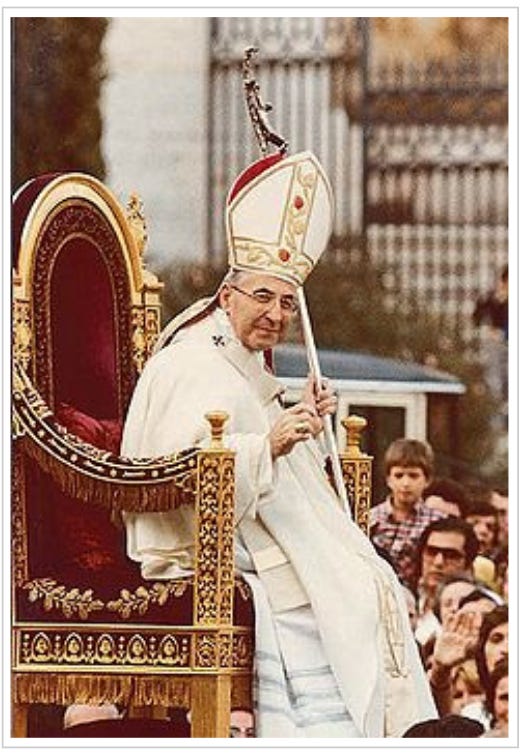
As an informative introductory aside we know that no pope has used the traditional sedia gestatoria for processing, since John Paul 1. And by the search result for the image below, he last used it the day of the night he died. Not sure if this detail is mentioned in the conspiracy lore, but the act of using the sedia gestatoria seems a reactionary gesture against its replacement under JP 2, his modified “Pope Mobile”, transport fit only for a tin-pot dictator. If murdered, and this must remain a possibility, perhaps the short reigned John Paul was too much a romantic for this stage of the revolt'? The sedia gestatoria certainly does look out of place against the brutalist backdrop of the Novus Ordo ecclesial aesthetic.
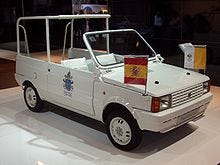
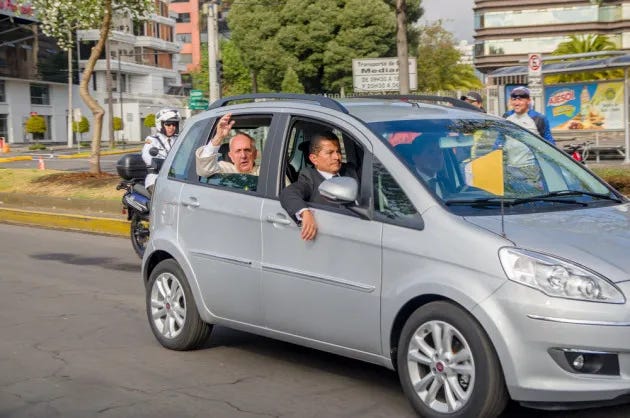
Irony is the rule of the day, for what better symbol against the excesses of industrial society that Francis rails against, than to be carried about by immediate human power, in an aesthetic context far from the industrial utility of the ‘Pope Buggy’ above. But such a servile social relation of men carrying a superior is anathema to social democratic sensibilities. It is not that the Pope Mobile was new, as a secular history in Hot Cars makes clear (Ha ha). It is not so much that the Pope Mobile replaced the older processional chair, but rather that the two vehicles were combined for a single purpose. Leaving the pope free to tool about in this humble ride, fit only for an uncrowned king. But I get ahead of myself. Let’s get back to the papal cathedra on tera firma.
There is no law that the cathedra must be of a certain kind, or be a certain one, to my knowledge anyway; I am happy to be corrected on this point though. And each Bishop of Rome since Paul 6 has sat on a papal chair of some kind, and has claimed to be a successor of St Peter in some way, though always with some claim of transforming the significance of the office. And this is most obviously true of Francis. It was telling as to Sedevacante when at the recent Synod Francis put the ancient throne of Peter on display: It had not been viewed by a pope since 1974, and not by the public since the 19th century. Though no pope has sat on that throne later than Alexander VII in the 17th century, who officially retired the Chair from ceremonial use in order to preserve the relic for posterity.
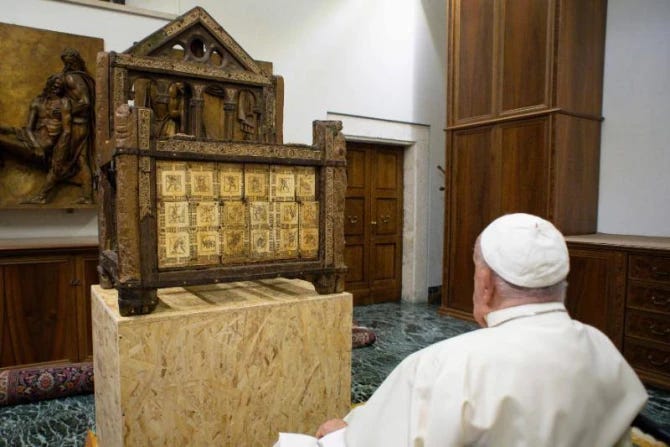
Yet, this retirement also brought a new more elaborate throne, designed by Bernini, reflecting changes in prosperity through the Renaissance. This was the third Chair of St Peter. There is, on record, reference for an original from St Peter himself, no longer extant. The one that Francis put on display originated from the 6th or 7th century. It has an acacia wood skeleton over which there are oak boards mounted with iron strapping. This of course to preserve elements of its predecessor. I offer a completely factually uninformed speculation that even the skeleton included parts from Peter’s own Chair, or its present form is a reconfiguration of the first Chair. I make this speculation because the skeleton is made of acacia wood, the same wood used to make the Ark of the Covenant, because it is often called “incorruptible”, and is an apt representation of our blessed Mother. That the Bernini Chair was made out of whole cloth materially, while assuming it maintained the ecclesiological form of the Chair is telling of a great confidence that the essence of the papal office is metaphysical. I certainly do not want to claim Sedevacante since the 17th century ! Yet this change is telling of major transformation from the middle ages toward the modern era. at a closer look at the image above, we see the base made to set St. Peter’s Chair on is made of unfinished OSB (Oriented Strand Board), a cheap replacement for plywood, common in contemporary construction. I must confess this realization fills me with anger, one of the most important relics of the Church, the very cause of Francis’ supposed authority, and it is placed on a stand I, a reasonably skilled carpenter, could slap together in under and hour !
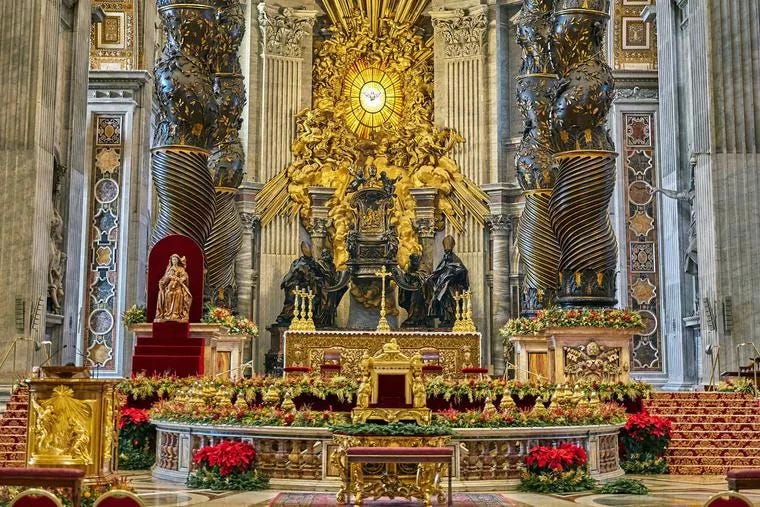
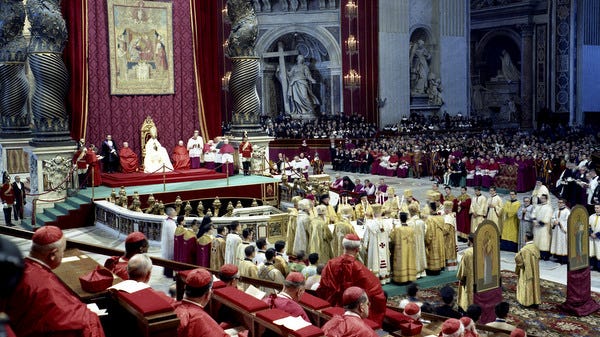
The Bishops of Rome since the council have used a variety of ‘personal’ chairs for various functions. As no post conciliar pope has overtly made Ex Cathedra statements, the ‘Papal Throne’ has only been used implicitly. I am uncertain if Paul 6 sat in Bernini’s Cathedra when he promulgated Vatican 2, but it seems most certain that Pius IX promulgated the Vatican council from this Chair. Ex Cathedra is surely more of metaphysical import, but to say this authority was not at all bound to speaking from the accepted Throne Chair, the visible Chair of the See, seems contrary to the symbolic meaning of the papacy within the Catholic Church.
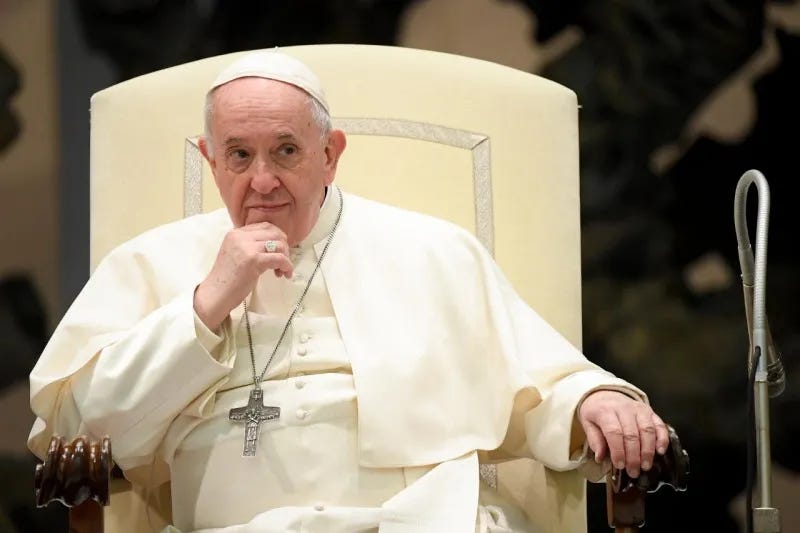
I cannot find and image of Paul 6 sitting in his newly constructed audience hall, but the chair pictured below with Francis in it, can be found also to be sat in by John Paul 2 and Benedict 16. It seems to be used in the Paul 6 Hall as the de facto Cathedra for general audiences. It is not hideous, and is a welcome relief to the institutional mood of the room and its contrasted cacophonous backdrop. Still, this chair bears no religious symbols whatever. As it is the ‘Seat’ of the chief ecumenical officer of the ‘people of God’, it must be in iconoclastic form, so as not to offend ‘our separated brethren’.
This throne below with John Paul 2 on it is telling of a total sense of liberty from the material throne entirely in assumption of its ecclesiological intention. To say this ‘Chair’ is just another like the bland one above, not the Cathedra, but a Cathedra is to be blind from the significance of symbols. The throne is grand if minimal. I am curious on what occasions JP2 used this chair, as said above, he can be found in the same chair Francis is sitting, yet for some, or at least one time he sat in this bespoke Chair to indicate his authority, to draw attention to himself for a particular purpose. The image is menacing to pious eyes. The inverted cross has been the cause of much speculation. As St Peter was hung on an inverted cross by his own request, there is an orthodox meaning. Still, the inversion is also a satanic symbol, as this ‘religion’ is nothing more than an inversion of Christianity. The devil is not a creator but a destroyer.
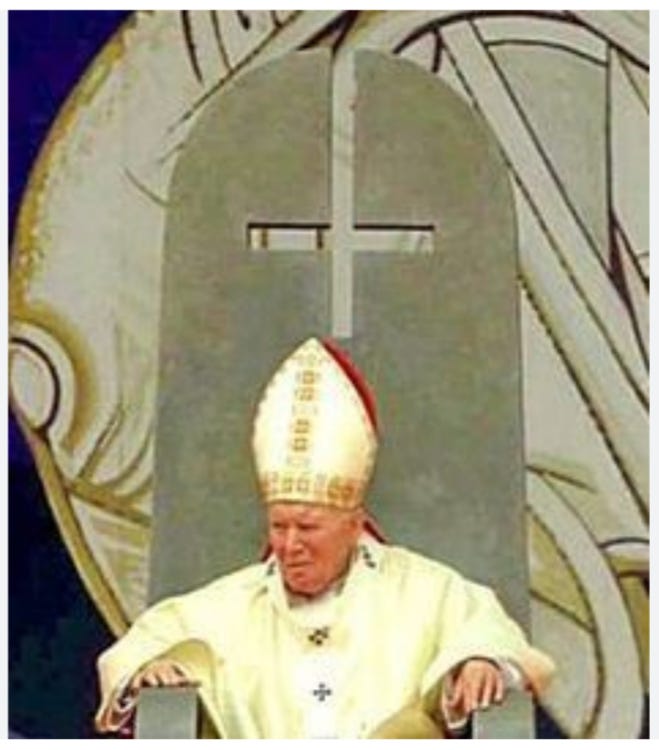
The image brings us back to our topic directly. We see JP 2 sitting on his brutalist throne, yet without a crown. The chair is as garish to traditionalists as Bernini’s is to moderns, to call this over sized slab “humble”, for all its austere greyness, would only be through ‘charitable blindness’; the chair shouts its ‘humility’. But why not a crown to match the change in style? On November 13th, 1964, after celebrating Mass during the Vatican 2, Paul 6 removed the crown and placed it on the altar at St Peter’s. It was to be sold and the proceeds donated to the poor. From a Katholisch.de article from November 13th of this year we see how this donation played out,
The New York Cardinal Francis Spellman endeavoured to obtain the crown; the Pope left it to the Americans as a sign of gratitude for their generous and long-term help for the poor. The tiara was then displayed in US dioceses for four years - always accompanied by an offering box and an appeal for donations for the poor. This is said to have raised many millions of dollars - allegedly 1.3 billion. The tiara has been kept in the Marian shrine in Washington since June 1968.
The German article gives the Modernist game away, describing this treasonous act in virtuous terms.
It was a simple ceremony - and one of the great gestures of the Second Vatican Council. On 13 November 1964 - at the end of a festive mass with Eastern Church patriarchs and dignitaries - Paul VI laid his tiara, the triple crown of the papacy, on the altar of St Peter's Basilica - as a gift to the poor of the world. "Viva il papa povero!" - long live the poor Pope - was applauded by those present. In doing so, Paul VI also renounced an emblem of spiritual and temporal power that no longer seemed in keeping with the times. (Emphasis mine.)
The problem here is renunciation of the emblem is renunciation of what the emblem signifies. So, we must see in this act a rejection of the traditional duties of office, if not an outright abdication. The tiara was liturgically imposed, bearing particular meaning. What did it mean for Paul 6 to take it off? There were no words of decoronation made, no liturgical redefinition of the papacy, just, as with the council documents themselves, and uncertain redefinition. No Bishop of Rome since has put on the Papal Crown, but have demoted themselves to the highest episcopal office only, wearing only a bespoke mitre. Though of course retaining, if at times uncertainly, the clout of implicit coronation. John Paul 2 retained the papal tiara as a symbol of office, but Benedict 16 retired it, and Francis followed suit, and upped the game by rendering “Vicar of Christ” as only a historic title. There is honesty in this relegation, Francis is not coronate, he cannot be Vicar of Christ, and hence cannot be Bishop of the universal Church.
It seems that each pope through the ages had his own crown made to fit, and there is not a single one that has continued in use over time, like the previous thrones had been. So, it is wrong to think the crown had to be of an absolutely certain kind, or be a certain one. Yet, it is not outrageous to expect that there should be a crown of some kind. And the gesture of Paul 6 seems to be a major revocation hidden within a seemingly spontaneous magnanimous gesture, so subtle that the true meaning of the gesture can go unnoticed.
It has been argued that Paul 6’s de-coronation indicated the end only of the temporal power of the papacy. This is an uncertain thesis; firstly, this was not true, there was no change in Paul 6’s temporal authority over Vatican City. And it was only back in 1927 that the Bishop of Rome had regained authority over Vatican City, after the loss of the Papal States in the 19th century. Even if we accept that this was the meaning of his gesture, temporal authority was only represented by one of the rings on the Triregnum, the lowest tier. It should be assumed that the papacy retained the spiritual headship, and the ecclesial headship, and the post conciliar popes have all claimed this authority, but to diminishing degrees. The Synod on Synodality being a mongrel breed both of the unquestioned authority of the pope mixed with the implementation of a major reassignment and reduction of papal authority. The Synod places infallibility on the sensus fidei of all the ‘People of God’. And paragraph 22 of the final document of the Synod makes the following claim that would have been outrageous to make less than a century ago;
22. Through Baptism, “the holy People of God has a share, too, in the prophetic role of Christ, when it renders Him a living witness, especially through a life of faith and charity” (LG 12). The anointing by the Holy Spirit received at Baptism (cf. 1 Jn 2.20. 27) enables all believers to possess an instinct for the truth of the Gospel. We refer to this as the sensus fidei. This consists in a certain connaturality with divine realities based on the fact that, in the Holy Spirit, the Baptised become “sharers [participants] in the divine nature” (DV 2).
Do we see in this the fulfillment of Paul 6’s intention to donate the crown of the office to the poor? How many truly impoverished people were at the synod as lay delegates? Or, are all the lay members counted as ‘the poor’? For all this, even if the post conciliar popes refused temporal power, why did they not retain a two tiered crown? Again, in a social order built on symbols which signify metaphysical ‘objects’, to expect, under continuity of tradition, that the popes after Vatican 2 would continue to wear a crown at least of two tiers, is hardly scrupulosity. It is far more outrageous that Paul 6 took it off to begin with, and that the people cheered, “Papa Poveri”, Pope of the Poor, to honour the event. What did he think it meant in full, did he really think this through?
I presume to offer that in this self-abnegation by Paul 6, and the implied continued abnegation of all subsequent ‘popes’, is a symbol writ large for any willing to see, that none of these men intended to be the pope in the sense that gives the office its true meaning, and is the metaphysical ground of its authority. By refusing the rite of coronation, all these men have been mere usurpers of the Chair, and in this supposed act of humility they have made themselves, their bodily form, that which validates their ‘Throne’, “Grab a chair, any one will do, as long as I am sitting on it!” Yet, how can an uncrowned man be enthroned?
By this view the Sede is not truly vacante, but rather is usurpata. Or, is it better to say that the true throne is empty, this symbolized by Francis above looking on at the empty Chair of St Peter, the usurper occupying another throne set up against it, to replace it, to divest itself of its Petrine duties and yet to block the way from a worthy occupant, who could humble himself to wear the crown, to occupy the Chair validly, and to once again rule with clarity over the Church. May we make ourselves worthy of such a Father.
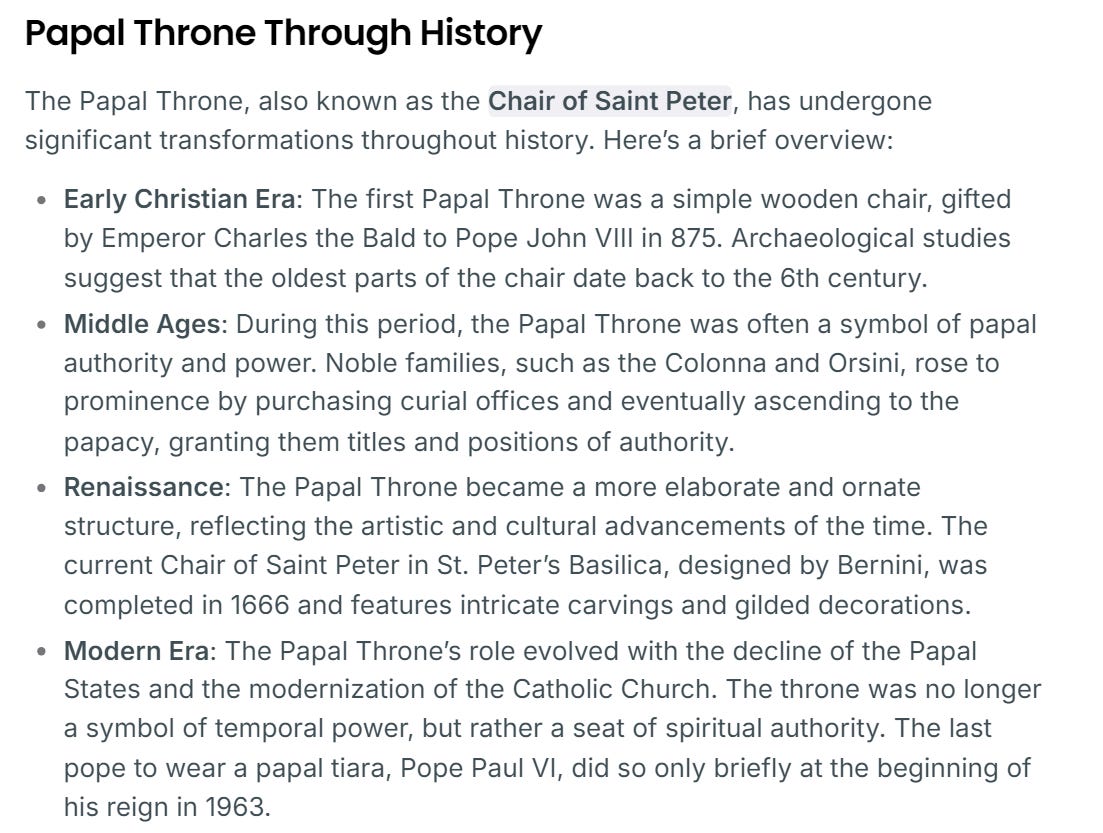
If anyone has more historical details to offer me in this study that would be greatly appreciated. I believe the general facts presented here are truthful, but am quite happy to be corrected. the following is a screen shot from a Google search for “Chair of Saint Peter. The facts are presented quite truthfully from a disinterested view. And for an AI production, the summary does a subtle job of blurring the difference between the physical Chair and its authority.
This thesis is continued in Remota Caronum.